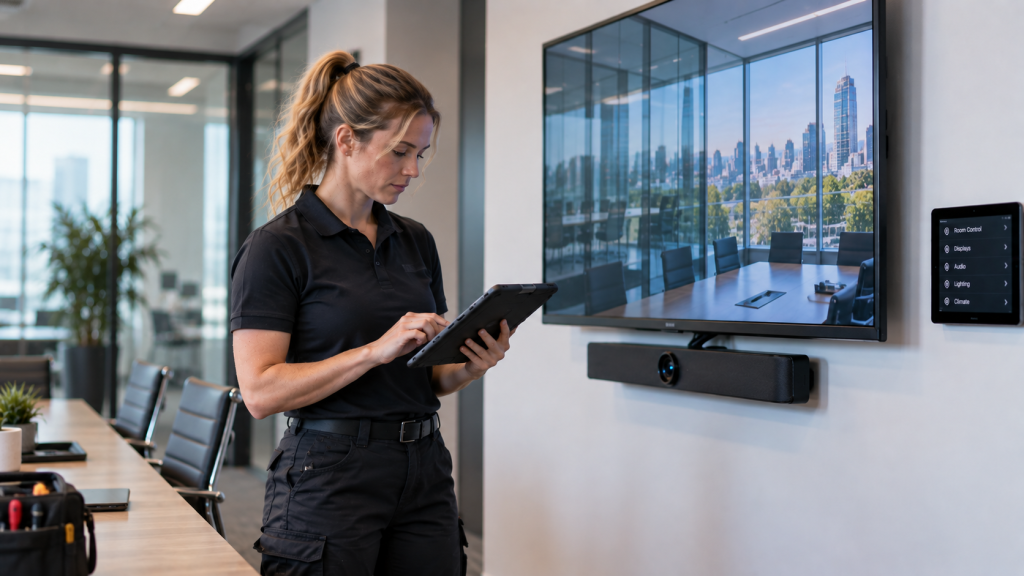
The commercial AV landscape is evolving faster than most IT service providers can track. New display technologies, cloud managed infrastructure, and hybrid workplace demands are fundamentally changing what clients expect from audio visual installation, integration, and ongoing support. For providers that need additional field coverage, Cloudwork|PRO gives you access to commercial AV technicians for installation and support across the country.
This post breaks down the most important trends reshaping commercial audio visual solutions and explains how forward thinking providers can position themselves to capture more of this growing market.
Why Commercial AV Is a Priority Right Now
Businesses across every vertical are investing heavily in their physical spaces to support remote collaboration, client facing presentations, and employee engagement. According to Grand View Research, the global AV market is projected to grow significantly through 2030, driven by demand for conference room AV installation, digital signage, and unified communications platforms.
For IT service providers, this growth represents a direct revenue opportunity. However, capturing that revenue requires more than basic AV equipment installation. Clients increasingly want a single partner who can handle commercial AV installation, ongoing AV maintenance services, and AV repair under one coordinated service model.
Trend 1: The Rise of Hybrid Ready Conference Rooms
Perhaps the most dominant force shaping commercial AV right now is the hybrid workplace. Companies are retrofitting existing offices and building new ones with conference room setups designed for seamless video collaboration.
This shift is creating enormous demand for conference room AV installation as decision makers look for local commercial AV installers who understand platforms like Microsoft Teams Rooms, Zoom Rooms, and Cisco Webex. In addition, clients expect these systems to be scalable, easy to manage remotely, and integrated with their existing network infrastructure.
For IT service providers, this is a natural extension of existing service lines. You already manage the network. Therefore, positioning your team as the audio visual integrator for conference room buildouts is a logical and profitable next step. Our Complete Guide to Conference Room AV Installation for Modern Businesses covers the technical and business considerations in detail.
Trend 2: AV over IP Is Replacing Traditional Signal Distribution
Traditional matrix switchers and point to point HDMI runs are giving way to AV over IP architectures. This approach routes audio and video signals across standard network infrastructure, dramatically simplifying large scale AV systems installation and making commercial audio visual installation more flexible and cost effective.
For IT service providers, AV over IP is particularly significant. Your team already understands network switching, VLANs, and bandwidth management. Consequently, the technical foundation for AV over IP is ground you already cover. Adding this capability to your service catalog positions you as a true audio visual integrator rather than a vendor who simply mounts screens.
Furthermore, AV over IP systems require ongoing maintenance, monitoring, and periodic AV maintenance services, which creates recurring revenue streams that support long term client relationships.
Trend 3: Digital Signage as a Managed Service
Digital signage has matured from a standalone product into a fully managed service category. Businesses want dynamic content across multiple locations, centrally managed and monitored. As a result, commercial audio visual companies that offer digital signage as a subscription based managed service are capturing clients who would otherwise choose a competitor.
If your MSP or IT service business is not currently offering digital signage, you may already be losing revenue to competitors. Our post on why MSPs are sending digital signage clients to competitors explains exactly where that profit leak is occurring and how to close it.
Similarly, managed digital signage ties directly into ongoing digital signage installation and support services that extend your client engagement beyond the initial install.
Trend 4: Demand for Integrated AV and Security Systems
Modern commercial spaces increasingly require AV and physical security systems to work together. Display systems now integrate with access control platforms and CCTV infrastructure to create unified building environments. For example, a corporate lobby screen can display real time occupancy data, visitor check in prompts, or emergency alerts triggered by security events.
This convergence means that clients searching for an audio visual company near me or commercial AV companies near me are often looking for a provider who can handle AV alongside their broader technology stack. IT service providers who already manage security systems are therefore uniquely positioned to offer this integrated value proposition.
Trend 5: AV Maintenance and Repair as a Recurring Revenue Line
One area where IT service providers consistently undercharge is post installation support. Audio visual equipment repair services, AV repair, and AV maintenance are high value offerings that clients genuinely need but rarely find a reliable provider for.
Businesses that invest in commercial AV installations want confidence that their systems will stay operational. However, many commercial AV companies disappear after the install, leaving clients scrambling when something breaks. Offering structured AV maintenance services and audio visual support services creates predictable monthly revenue while differentiating your business from commodity installers.
In addition, proactive maintenance catches issues before they become expensive problems, which clients appreciate and which reduces your own support overhead over time. Pairing reactive audio visual repair capabilities with scheduled maintenance contracts is a highly effective service packaging strategy.
Trend 6: Scalable Field Labor Through Technician Marketplaces
One of the biggest operational challenges for commercial AV installation is labor. Hiring full time audio visual installers for every market is not financially viable for most IT service providers. However, turning down multi site projects because you lack boots on the ground is equally costly.
The solution increasingly used by commercial AV companies is on demand technician marketplaces. These platforms allow providers to expand into new markets and take on larger projects without building a full time field team in every location. With Cloudwork|PRO, you can access commercial AV installation technicians nationwide for deployments, installations, maintenance, and other onsite AV work.
Our post on how enterprise companies use technician marketplaces to scale field operations outlines exactly how this model works. You can also explore how commercial AV installers are cutting labor costs without cutting quality for additional strategic context.
Positioning Your Business for the AV Opportunity
The trends above point in a consistent direction. Commercial audio visual solutions are becoming more complex, more integrated, and more dependent on ongoing managed services. IT service providers who recognize this early have a significant first mover advantage.
The key steps are clear. First, evaluate which AV service lines align naturally with your existing capabilities. Second, build or access the labor infrastructure to deliver commercial AV installation at scale. Third, package AV maintenance services and audio visual support services into recurring contracts rather than one time engagements.
The businesses searching for an audio visual integrator, an AV installer near me, or corporate audio visual services near them are your next clients. The question is whether your business is positioned to win them.
Ready to expand your commercial AV service capabilities? Book a demo with Cloudwork|PRO to see how our nationwide technician network can help you scale audio visual installation services without adding fixed overhead.
Frequently Asked Questions
1. What is commercial audio visual integration?
Commercial audio visual integration is the process of designing, installing, and configuring AV systems including displays, speakers, video conferencing equipment, and control systems so they work together seamlessly within a business environment. An audio visual integrator typically handles everything from site assessment through post installation support.
2. How do I find a reliable audio visual company near me?
Search for commercial AV companies with verifiable project experience, background checked technicians, and structured maintenance contracts. In addition, look for providers who understand your specific environment, whether that is conference rooms, retail spaces, or corporate campuses. Technician marketplaces like Cloudwork|PRO can also give businesses access to vetted AV installers across the country.
3. What does AV maintenance typically include?
AV maintenance services typically include routine equipment inspections, firmware and software updates, cable and connection checks, display calibration, and priority response for audio visual repair when issues arise. Comprehensive AV maintenance contracts reduce downtime and extend equipment lifespan.
4. Why should IT service providers offer commercial AV installation?
Commercial AV installation is a natural extension of IT services because modern AV systems run on network infrastructure that IT providers already manage. Furthermore, offering audio visual installation services alongside networking and security eliminates the need for clients to manage multiple vendors, increasing your value and reducing client churn.
5. What is AV over IP and why does it matter for businesses?
AV over IP distributes audio and video signals across standard IP network infrastructure instead of dedicated cabling or matrix switchers. It simplifies large scale AV systems installation, reduces hardware costs, and makes systems easier to manage and scale. For IT service providers, it also means AV infrastructure becomes part of the managed network environment.
6. How much does commercial AV installation typically cost?
Commercial AV installation costs vary based on room size, system complexity, equipment, and labor. A basic conference room setup may cost $3,000 to $8,000, while large corporate AV installations can exceed $100,000. With Cloudwork|PRO, you can hire commercial AV technicians on a one off basis instead of hiring an entire AV company, helping you keep labor costs flexible. For more cost comparisons, see our breakdown of in house vs. outsourced installation costs.


